

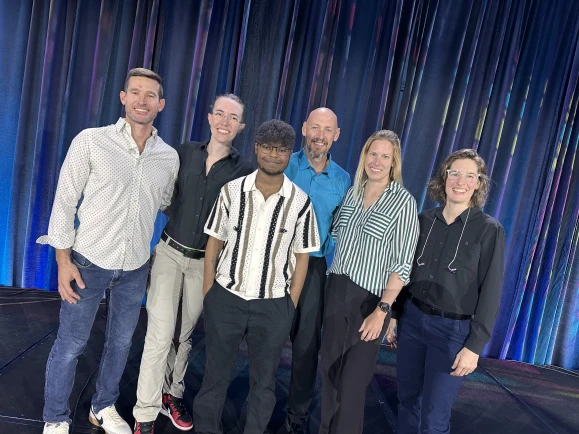
A thousand pastors and church leaders from around the country crowded into the ballroom of the Hyatt Regency hotel in St. Louis this past June and waited for Shelby Pride and the First Baptist praise band to start playing.
Founded in 1991, the Cooperative Baptist Fellowship gathers like this each year for a general assembly. There are business meetings, a vendors fair, professional development workshops, and a trio of church-like services with preaching and worship.
Traditionally, the music selection at these services was just that — traditional. Old-school hymns set to the rhythms of guitar were the standard. When a CBF director first emailed Pride to ask if she’d be willing to lead worship at the 2025 assembly, she did a double-take.
“You know I’m a contemporary worship leader, right?” asked Pride, the praise band director.
They did. And they wanted her to bring her contemporary style to the gathering.
That’s not all Pride wanted to bring.
Before she accepted the invitation, Pride needed to know that she would be able to represent all of what First Baptist is, who her band is, and what she is as a worship leader.
“I hold space,” Pride says, by which she means that she doesn’t impose on her worshippers or her bandmates. She has just three rules to be in her band: Be connected, be creative, and have fun. She requires no statement of faith or, even, faith at all. Doubts are welcome.
The result is a band that couldn’t come together any other way: musicians who are queer, who’ve been hurt by and are wary of the church, who decline to conform to a another’s creed or confession.
We still want you, CBF said. The network comprises a wide range of religious expressions, including FBC’s.
That sounds safe enough, Pride thought. She accepted.
Rehearsals began in March for the June assembly. The team prepared, on top of their regular work for FBC’s weekly services, nearly 30 songs to play during pre-worship — the period before the service begins, as attendees file into their seats — and nearly 20 to play during the two services they performed.
The titles were curated carefully. Among them was “All Belong Here” by The Many, a diverse worship collective committed to racial justice and inclusion. Also, tucked into the pre-service set, were numbers by Flamy Grant, a queer Christian pop singer who performs in drag.
Because Pride couldn’t take the whole band with her, she had the hard task of choosing. She brought Easton Kerns on drums, Kimberly Moller on saxophone, Emily Reinhart on bass and mandolin, Zach Schulte on keyboard and bass, and Pete Walter on electric guitar.
The group was committed to the performances. Over the four months of practice they “blossomed” as artists, Pride says, as they engaged with the music and sought ways to play it differently and better. “It pushed me as a leader. I was taking great feedback and just went with it.”
June finally came, and they arrived at the Hyatt for the conference. A professional sound team met them, patched their assembled equipment into the sounds system, and made sure it worked. For a do-it-yourself band, that was a first. They knew they weren’t in Columbia anymore.
The Hyatt ballroom is massive. Stepping out for the first performance, the stage lights were so bright they couldn’t see anything beyond the front row. They didn’t need to. When they looked out, all they saw were the smiling, enthusiastic faces of First Baptist’s pastors — including former pastor Carol McIntyre — right up front.
“It felt like home,” Pride says.
The band settled in and played. There was no lighting-strike, hand-of-God moment during the service, but they weren’t going for something forcible. They just wanted to make space.
Afterward, they knew they’d struck a chord, and not just because of the several people who thought they were a professional band and wanted to follow them on Spotify.
“I didn’t know any of the words, but it didn’t matter,” Pride remembers one person telling her after the service. “I just knew when you started playing that this was a place of worship, and I could engage however I felt comfortable.”
In Pride’s day job, she runs her own counseling practice. But she was a worship leader first, and the idea of saving space and allowing others to be their empowered, authentic selves is an idea she brought with her from the platform to her practice. Her psychology training has only reinforced its importance.
“You had that experience in worship because all of me showed up,” Pride says. “I got to be fully myself with other people who were fully themselves, representing a church that is not ashamed of who we are.
“I was flooding the stage with queer people and allies, and you met God, in this space, with my team.”