

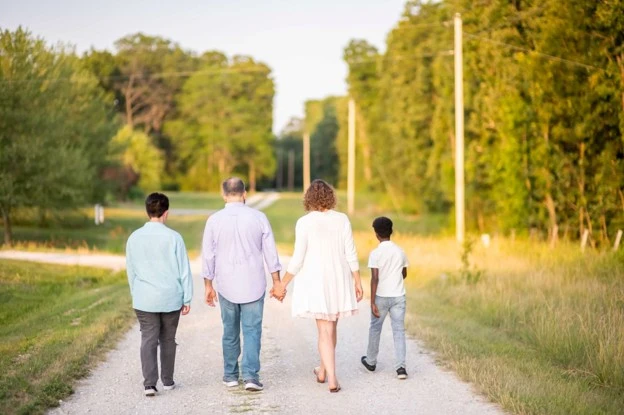
What My Children Taught Me About God's Love
By Sarah Banks (she/her)
“I didn’t realize how hard it was to feel like an outcast,” said the white, Christian, Midwestern woman who lived an easy and safe life with her white, Christian, Midwestern husband in their white, Christian, Midwestern town.
Soon after giving birth to a daughter, these two well-meaning white folks decided it would be a good thing to adopt their next child: a Black son from Ethiopia. “Race doesn’t matter,” they told themselves with the kind of confidence that came from never having had to think very hard about race.
As an adorable 4-year-old, our son came home to meet his older sister and complete our family on Christmas Eve 2015.
The following months and years were eye-opening to me. Being the Mom of a precious Black son made it impossible to avoid to the bigotry still very prevalent in this white, Christian, Midwestern town. A bigotry that I previously had the privilege to ignore.
In 2022, our biological child began questioning gender and sexuality. We switched gears from reading books about race to reading books about LGBTQIA+ identities, including Unconditional: A Guide to Loving and Supporting Your LGBTQ Child. Our older child now has a new name and uses he/him pronouns.
After coming out, he lost several friends and struggled through depression as he sought to understand his identity. Some people distanced themselves from us or told us we were wrong for continuing to support our child, using words like “sinful” to describe his life. Likewise, our church said this was a sin and that “she” must repent. Raising a Black child had already opened my eyes to racism in ways I could no longer ignore, and I do not want to suggest that racism is mild or rare, but much of what we personally encountered had been easier for others to dismiss, explain away, or pretend not to see. The rejection our oldest faced after coming out as transgender was harder to disguise. Just as raising our Black son opened my eyes to racism that I didn’t notice before, our older child’s coming out opened my eyes to how much I still had to learn about LGBTQIA+ people — not as an issue to debate, but as beloved children of God trying to live truthfully as who they are.
There have been glimpses of beauty on this bumpy road. One of those was a new church which we started attending - First Baptist Church, Columbia. For two somewhat conservative evangelical Christians, one of whom was raised Southern Baptist, we were a little confused as to why a friend would have recommended a Baptist church when we were looking for a safe place for our LGBTQ child, but that is exactly what we found at First Baptist. We soon learned that First Baptist is not part of the Southern Baptist Convention (SBC), but part of the Cooperative Baptist Fellowship — a Baptist tradition shaped, in part, by concern over the fundamentalist direction of the SBC.
At First Baptist, we met other interracial families who had also adopted children. We found members of the LGBTQIA+ community, not just in the pews but leading as well. Most importantly, we found a community of people who are loving and supportive - not in contradiction to the word of God - but because of it.
Earlier this year First Baptist hosted a gay drag queen who writes and performs Christian music under the stage name Flamy Grant. As one who helped with much of the marketing for the concert, I was quite certain from the social media backlash that I had personally destroyed our church. The Pastors reassured me that I hadn’t and the concert went on as planned.
The concert was such a beautiful experience. Many who packed our sanctuary that cold January night had never been in church or had not been in years. Others told us that they wanted to come but still weren’t ready to be in a church. Some came with fear, with haunted memories of being rejected by families, churches, and, in their minds, God.
I thought about my own journey over the past three years with my child coming out as transgender. There are countless stories where this is treated as the end: families broken, a father or mother turning their back on a child, love that had limits and conditions. If I, an imperfect image of God’s love, can love my child fully and without condition, how much more does God love him, and each one of us?
I know all the verses - all of Paul’s lists of sins - all the Old Testament “shalt nots,” but overwhelmingly what I take from the Bible as a whole, when I’m not slashing out verses with a razor blade is that God loves us and Christ died for us, for all of us. So unapologetically, this isn’t who I’ve always been, but this is who God has shaped me to be. Since God won’t give me any feeling other than love towards my kids, I can only assume I should keep reflecting that love as long as I have days on this earth.
I’m not telling my story to say that I am doing better at inclusion than anyone else would. I’m telling it because church should be a place where we are brave enough to let God stretch the boundaries of who we think we are and who we think belongs. Get to know someone who is different from you. Listen to the stories that make you uncomfortable. Bigotry is alive and well in our small towns and our big cities, and there are people all around us who need kindness and love more than judgment and derision. If God’s love is wider than we can imagine, then church should be a place where people catch glimpses of that love.